



Lacustricola pygmaeus Bragança, Skelton, Bills, Tweddle & Chakona, 2021
อัพโหลดของคุณ ภาพถ่าย และ วิดีโอ
Google image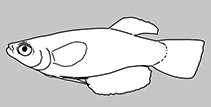 No image available for this species;
drawing shows typical species in Procatopodidae.
Google image
drawing shows typical species in Procatopodidae.
การจำแนกประเภท / ชื่อ ชื่อสามัญ | ชื่อพ้อง | Catalog of Fishes(สกุล, ชนิด) | ITIS | CoL | WoRMS | Cloffa
> Cyprinodontiformes (Rivulines, killifishes and live bearers) > Procatopodidae (African lampeyes) > Procatopodinae
Etymology: pygmaeus: The epithet pygmaeus, from the Latin pygmaei (singular pygmaeus), is an allusion to the very small or miniature size of Lacustricola pygmaeus, the smallest species within the L. hutereaui complex (Ref. 123968).
Etymology: pygmaeus: The epithet pygmaeus, from the Latin pygmaei (singular pygmaeus), is an allusion to the very small or miniature size of Lacustricola pygmaeus, the smallest species within the L. hutereaui complex (Ref. 123968).
สิ่งแวดล้อม : สิ่งแวดล้อม / เขตภูมิอากาศ / ระดับความลึก / ระยะการกระจายสินค้า นิเวศวิทยา
; น้ำจืด ผิวน้ำ. Tropical
การแพร่กระจาย อาณาเขต | พื้นที่จำแนกตาม FAO | ระบบนิเวศหลายระบบ | การปรากฏขึ้น,การเกิดขึ้น,พบ | ตำแหน่งบนแผนที่ | การแนะนำ | Faunafri
Africa: Cuito, Cuanavale, and Okavango rivers, as well as Cuando and small upper Zambezi tributaries in a region comprising Angola and Zambia (Ref. 123968). Also known from Okavango Delta, Chobe River, in Botswana and Namibia and swamps of the Barotse floodplains in the upper Zambezi in Zambia, and Bukalo Channel in Namibia (Ref. 123968).
ขนาด / น้ำหนัก / อายุ
คำอธิบายสั้นๆ เครื่องมือที่ใช้ในการแยกชนิดสัตว์,สิ่งมีชีวิตออกจากกัน | สัณฐานวิทยา | ความยาวต่างๆ
เงี่ยงครีบหลัง (รวม) : 0; ก้านครีบอ่อนที่หาง (รวม) : 10 - 12; เงี่ยงครีบก้น: 0; ก้านครีบอ่อนที่ก้น: 12 - 15; สัตว์มีกระดูกสันหลัง: 24 - 26. Diagnosis: Lacustricola pygmaeus is distinguished from L. centralis, L. jobaerti, L. johnstoni, L. jubbi, L. katangae, L. macrurus, L. matthesi, L. mediolateralis, L. moeruensis, L. myaposae, L. nigrolateralis, and L. stiassnyae by the possession of banded dorsal, anal, and caudal fins in males and also by the possession of a pointed premaxilla ascending process, in which the premaxilla medial surface is slightly convex (Ref. 123968). It is further distinguished from L. hutereaui, L. chobensis, and L. petnehazyi by an inconspicuous reticulate pattern on scale margins vs. conspicuous; banded anal, dorsal, and caudal fins in females vs. hyaline; faint bands in the middle rays of caudal fin of male vs. conspicuous bands; rounded caudal fin in males vs. elliptical; bright green-blue colour restricted to the area delimited by some of the flank scales vs. bright green colouration not restricted to scale area in L. chobensis and L. petnehazyi, and absent in L. hutereaui; quadrate posterior margin with a deep concavity vs. convex or about straight; first dorsal-fin ray inserted in a vertical to second and third anal-fin ray vs. fourth to eight (Ref. 123968). It is further distinguished from L. hutereaui by the absence of maxilla ventral sharp process vs. presence; retroarticular about the same size as anguloarticular ventral process vs. shorter; posteroventral extension on lachrymal vs. rectangular, without posteroventral extension; infraorbital canal anterior portion open, with three to four neuromasts vs. closed, with four pores; mandibular canal open, with two small neuromasts vs. closed, with four pores; head neuromasts placed in shallow grooves or on the same level as head surface vs. on deep grooves; possession of chromatophores close to eye, along infraorbital region vs. absence of chromatophores; posttemporal ventral arm not ossified vs. ossified; and by a cleithrum posterodorsal bone flap rounded vs. sinuous (Ref. 123968). Lacustricola pygmaeus is further distinguished from L. petnehazyi by the possession of 20-22 scales on longitudinal series vs. 24-27, and from L. chobensis by the possession of 26-30 caudal-fin rays vs. 21-24; 10-12 dorsal-fin rays vs. 6-8; and chromatophores along whole mid-body line of flank, forming an inconspicuous line vs. conspicuous (Ref. 123968).
It is a swamp-dwelling species that does not occur in riverine habitats (Ref. 123968).
วงจรชีวิตและพฤติกรรมการผสมพันธุ์ วัยเจริญพันธุ์ | การสืบพันธุ์ | การวางไข่ | เซลสืบพันธ์ของเพศเมีย(ไข่) | ความดกของไข่ | ตัวอ่อน
อ้างอิงหลัก
อัพโหลดข้อมูลอ้างอิงของคุณ | อ้างอิง | ผู้ประสานงาน | ผู้ร่วมมือ
De Bragança, P.H.N., P.H. Skelton, R. Bills, D. Tweddle and A. Chakona, 2021. Revalidation and redescription of "Lacustricola" chobensis (Fowler, 1935) and description of a new miniature species of "Lacustricola" from southern Africa (Cyprinodontiformes: Procatopodidae). Ichthyol. Herpetol. 109(1):123-137. (Ref. 123968)
CITES
Not Evaluated
ภัยคุกคามต่อมนุษย์
Harmless
การใช้ของมนุษย์
FAO - Publication: search | FishSource |
ข้อมูลเพิ่มเติม
นิเวศวิทยาเขตร้อน
รายการอาหาร (เหยื่อ)
องค์ประอบของอาหาร
การบริโภคอาหาร
การจัดสรรอาหาร
ผู้ล่า
รายการอาหาร (เหยื่อ)
องค์ประอบของอาหาร
การบริโภคอาหาร
การจัดสรรอาหาร
ผู้ล่า
พลวัตของประชากร
พารามิเตอร์การเจริญเติบโต
อายุสูงสุด / ขนาด
ความยาว-น้ำหนักสัมพันธ์
ความยาว-ความยาวสัมพันธ์
ความยาว-ความถี่
การแปลงมวล
การทดแทนที่
อุดมสมบรูณ์
พารามิเตอร์การเจริญเติบโต
อายุสูงสุด / ขนาด
ความยาว-น้ำหนักสัมพันธ์
ความยาว-ความยาวสัมพันธ์
ความยาว-ความถี่
การแปลงมวล
การทดแทนที่
อุดมสมบรูณ์
วงจรชีวิต
การสืบพันธุ์
วัยเจริญพันธุ์
ความสมบูรณ์พันธุ์/เหงือกที่เกี่ยวข้อง
ความดกของไข่
การวางไข่
การรวมตัวของสปอน
เซลสืบพันธ์ของเพศเมีย(ไข่)
การพัฒนาไข่
ตัวอ่อน
พลวัตของสัตว์น้ำวัยอ่อน
การสืบพันธุ์
วัยเจริญพันธุ์
ความสมบูรณ์พันธุ์/เหงือกที่เกี่ยวข้อง
ความดกของไข่
การวางไข่
การรวมตัวของสปอน
เซลสืบพันธ์ของเพศเมีย(ไข่)
การพัฒนาไข่
ตัวอ่อน
พลวัตของสัตว์น้ำวัยอ่อน
การแพร่กระจาย
อาณาเขต
พื้นที่จำแนกตาม FAO
ระบบนิเวศหลายระบบ
การปรากฏขึ้น,การเกิดขึ้น,พบ
การแนะนำ
BRUVS - วิดีโอ
อาณาเขต
พื้นที่จำแนกตาม FAO
ระบบนิเวศหลายระบบ
การปรากฏขึ้น,การเกิดขึ้น,พบ
การแนะนำ
BRUVS - วิดีโอ
กายวิภาคศาสตร์
พื้นที่เหงือก
สมอง
หินโสต
พื้นที่เหงือก
สมอง
หินโสต
สรีรวิทยา
องค์ประกอบของร่างกาย
สารอาหาร
การใช้ออกซิเจน
ประเภทการว่ายน้ำ
ระดับความเร็วในการว่ายน้ำ
เม็ดสีที่มองเห็นได้
เสียงปลา
โรคและปรสิต
ความเป็นพิษ (LC50s)
องค์ประกอบของร่างกาย
สารอาหาร
การใช้ออกซิเจน
ประเภทการว่ายน้ำ
ระดับความเร็วในการว่ายน้ำ
เม็ดสีที่มองเห็นได้
เสียงปลา
โรคและปรสิต
ความเป็นพิษ (LC50s)
พันธุศาสตร์
จีโนม
พันธุศาสตร์
ความไม่สมดุลทางเชื้อชาติ
อัตราพันธุกรรม
ความหลากหลายทางพันธุกรรม
จีโนม
พันธุศาสตร์
ความไม่สมดุลทางเชื้อชาติ
อัตราพันธุกรรม
ความหลากหลายทางพันธุกรรม
เกี่ยวข้องกับมนุษย์
ระบบการเพาะเลี้ยงสัตว์น้ำ
ประวัติการเพาะเลี้ยงสัตว์น้ำ
สายพันธุ์
กรณีซิเกวเทอรา
แสตมป์ เหรียญ อื่นๆ
ระบบการเพาะเลี้ยงสัตว์น้ำ
ประวัติการเพาะเลี้ยงสัตว์น้ำ
สายพันธุ์
กรณีซิเกวเทอรา
แสตมป์ เหรียญ อื่นๆ
เครื่องมือ
หนังสืออิเล็กทรอนิกส์ | คู่มือภาคสนาม | ผู้มีความชำนาญในเรื่องความถี่ของความยาว | เครื่องมือในการศึกษาชีวประวัติ | ตำแหน่งบนแผนที่ |
จับ-MSY |
รายงานพิเศษ
ตรวจสอบการบำรุงรักษาตู้ปลา | ตรวจสอบเอกสารข้อเท็จจริงเกี่ยวกับสายพันธุ์ | ตรวจสอบเอกสารข้อเท็จจริงเกี่ยวกับการเพาะเลี้ยงสัตว์น้ำ
ดาวน์โหลด XML
หน้าสรุป | ข้อมูลสำคัญ | ชื่อสามัญ | ภาพถ่าย
แหล่งที่มาจากอินเตอร์เน็ต
AFORO (otoliths) | Aquatic Commons | BHL | Cloffa | Websites from users | Check FishWatcher | CISTI | Catalog of Fishes: สกุล, ชนิด | DiscoverLife | ECOTOX | FAO - Publication: search | Faunafri | Fishipedia | Fishtrace | GloBI | Google Books | Google Scholar | Google | IGFA World Record | OneZoom | Open Tree of Life | Otolith Atlas of Taiwan Fishes | PubMed | Reef Life Survey | Socotra Atlas | TreeBase | แผนภูมิชีวิตแบบต้นไม้ | Wikipedia: Go, ค้นหา | World Records Freshwater Fishing | Zoobank | บันทึกทางด้านสัตววิทยา
การประมาณค่าตามแบบจำลอง
ดัชนีความหลากหลายทางวิวัฒนาการ (อ้างอิง 82804): PD50 = 0.5000 [Uniqueness, from 0.5 = low to 2.0 = high].
Bayesian length-weight: a=0.01122 (0.00514 - 0.02450), b=3.04 (2.87 - 3.21), in cm total length, based on all LWR estimates for this body shape (Ref. 93245).
ระดับชั้นอาหาร (อ้างอิง 69278): 3.0 ±0.3 se; based on size and trophs of closest relatives