



Lacustricola pygmaeus Bragança, Skelton, Bills, Tweddle & Chakona, 2021
Envoyez vos Photos et vidéos
Images Google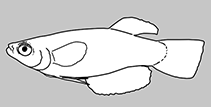 No image available for this species;
drawing shows typical species in Procatopodidae.
Images Google
drawing shows typical species in Procatopodidae.
Classification / Noms Noms communs | Synonymes | Catalog of Fishes(Genre, Espèce) | ITIS | CoL | WoRMS | Cloffa
> Cyprinodontiformes (Rivulines, killifishes and live bearers) > Procatopodidae (African lampeyes) > Procatopodinae
Etymology: pygmaeus: The epithet pygmaeus, from the Latin pygmaei (singular pygmaeus), is an allusion to the very small or miniature size of Lacustricola pygmaeus, the smallest species within the L. hutereaui complex (Ref. 123968).
Etymology: pygmaeus: The epithet pygmaeus, from the Latin pygmaei (singular pygmaeus), is an allusion to the very small or miniature size of Lacustricola pygmaeus, the smallest species within the L. hutereaui complex (Ref. 123968).
Environnement : milieu / zone climatique / profondeur / gamme de distribution Écologie
; eau douce pélagique. Tropical
Distribution Territoires | Zones FAO | Écosystèmes | Occurrences | Carte par point | Introductions | Faunafri
Africa: Cuito, Cuanavale, and Okavango rivers, as well as Cuando and small upper Zambezi tributaries in a region comprising Angola and Zambia (Ref. 123968). Also known from Okavango Delta, Chobe River, in Botswana and Namibia and swamps of the Barotse floodplains in the upper Zambezi in Zambia, and Bukalo Channel in Namibia (Ref. 123968).
Taille / Poids / Âge
Description synthétique Clés d'identification | Morphologie | Morphométrie
Épines dorsales (Total) : 0; Rayons mous dorsaux (Total) : 10 - 12; Épines anales: 0; Rayons mous anaux: 12 - 15; Vertèbres: 24 - 26. Diagnosis: Lacustricola pygmaeus is distinguished from L. centralis, L. jobaerti, L. johnstoni, L. jubbi, L. katangae, L. macrurus, L. matthesi, L. mediolateralis, L. moeruensis, L. myaposae, L. nigrolateralis, and L. stiassnyae by the possession of banded dorsal, anal, and caudal fins in males and also by the possession of a pointed premaxilla ascending process, in which the premaxilla medial surface is slightly convex (Ref. 123968). It is further distinguished from L. hutereaui, L. chobensis, and L. petnehazyi by an inconspicuous reticulate pattern on scale margins vs. conspicuous; banded anal, dorsal, and caudal fins in females vs. hyaline; faint bands in the middle rays of caudal fin of male vs. conspicuous bands; rounded caudal fin in males vs. elliptical; bright green-blue colour restricted to the area delimited by some of the flank scales vs. bright green colouration not restricted to scale area in L. chobensis and L. petnehazyi, and absent in L. hutereaui; quadrate posterior margin with a deep concavity vs. convex or about straight; first dorsal-fin ray inserted in a vertical to second and third anal-fin ray vs. fourth to eight (Ref. 123968). It is further distinguished from L. hutereaui by the absence of maxilla ventral sharp process vs. presence; retroarticular about the same size as anguloarticular ventral process vs. shorter; posteroventral extension on lachrymal vs. rectangular, without posteroventral extension; infraorbital canal anterior portion open, with three to four neuromasts vs. closed, with four pores; mandibular canal open, with two small neuromasts vs. closed, with four pores; head neuromasts placed in shallow grooves or on the same level as head surface vs. on deep grooves; possession of chromatophores close to eye, along infraorbital region vs. absence of chromatophores; posttemporal ventral arm not ossified vs. ossified; and by a cleithrum posterodorsal bone flap rounded vs. sinuous (Ref. 123968). Lacustricola pygmaeus is further distinguished from L. petnehazyi by the possession of 20-22 scales on longitudinal series vs. 24-27, and from L. chobensis by the possession of 26-30 caudal-fin rays vs. 21-24; 10-12 dorsal-fin rays vs. 6-8; and chromatophores along whole mid-body line of flank, forming an inconspicuous line vs. conspicuous (Ref. 123968).
It is a swamp-dwelling species that does not occur in riverine habitats (Ref. 123968).
Cycle de vie et comportement reproducteur Maturité | Reproduction | Frai | Œufs | Fécondité | Larves
Référence principale
Téléchargez vos références | Références | Coordinateur | Collaborateurs
De Bragança, P.H.N., P.H. Skelton, R. Bills, D. Tweddle and A. Chakona, 2021. Revalidation and redescription of "Lacustricola" chobensis (Fowler, 1935) and description of a new miniature species of "Lacustricola" from southern Africa (Cyprinodontiformes: Procatopodidae). Ichthyol. Herpetol. 109(1):123-137. (Ref. 123968)
CITES
Not Evaluated
Menace pour l'homme
Harmless
Utilisations par l'homme
FAO - Publication: search | FishSource |
Plus d'informations
Écologie trophique
Aliments (proies)
Composition du régime alimentaire
Consommation alimentaire
Rations alimentaires
Prédateurs
Aliments (proies)
Composition du régime alimentaire
Consommation alimentaire
Rations alimentaires
Prédateurs
Dynamique des populations
Paramètres de croissance
Âges / tailles maximales
Longueur-poids rel.
Rel. longueur-longueur.
Fréquences de longueurs
Conversion de masse
Recrutement
Abondance
Paramètres de croissance
Âges / tailles maximales
Longueur-poids rel.
Rel. longueur-longueur.
Fréquences de longueurs
Conversion de masse
Recrutement
Abondance
Cycle de vie
Reproduction
Maturité
Maturité/épines rel.
Fécondité
Frai
Agrégats de frai
Œufs
Développement de l'œuf
Larves
Dynamique des populations larvaires
Reproduction
Maturité
Maturité/épines rel.
Fécondité
Frai
Agrégats de frai
Œufs
Développement de l'œuf
Larves
Dynamique des populations larvaires
Anatomie
Surface branchiale
Cerveau
Otolithe
Surface branchiale
Cerveau
Otolithe
Physiologie
Composition corporelle
Nutriments
Consommation d'oxygène
Type de natation
Vitesse de nage
Pigments visuels
Son de poisson
Maladies et parasites
Toxicité (CL50)
Composition corporelle
Nutriments
Consommation d'oxygène
Type de natation
Vitesse de nage
Pigments visuels
Son de poisson
Maladies et parasites
Toxicité (CL50)
Génétique
génôme
Génétique
Hétérozygotie
Héritabilité
Diversité génétique
génôme
Génétique
Hétérozygotie
Héritabilité
Diversité génétique
Liées à l'homme
Systèmes d'aquaculture
Profils d'aquaculture
Souches
Cas de ciguatera
Timbres, pièces de monnaie, divers
Systèmes d'aquaculture
Profils d'aquaculture
Souches
Cas de ciguatera
Timbres, pièces de monnaie, divers
Outils
E-book | Guide de terrain | Générateur de fréquences de longueur | Outil de dynamique de population | Carte par point |
Capture-MSY |
Articles particuliers
Télécharger en XML
Sources Internet
AFORO (otoliths) | Aquatic Commons | BHL | Cloffa | Websites from users | FishWatcher | CISTI | Catalog of Fishes: Genre, Espèce | DiscoverLife | ECOTOX | FAO - Publication: search | Faunafri | Fishipedia | Fishtrace | GloBI | Google Books | Google Scholar | Google | IGFA World Record | OneZoom | Open Tree of Life | Otolith Atlas of Taiwan Fishes | PubMed | Reef Life Survey | Socotra Atlas | TreeBase | Arbre de Vie | Wikipedia: aller à, chercher | World Records Freshwater Fishing | Zoobank | Zoological Record
Estimations basées sur des modèles
Indice de diversité phylogénétique (Réf. 82804): PD50 = 0.5000 [Uniqueness, from 0.5 = low to 2.0 = high].
Bayesian length-weight: a=0.01122 (0.00514 - 0.02450), b=3.04 (2.87 - 3.21), in cm total length, based on all LWR estimates for this body shape (Ref. 93245).
Niveau trophique (Réf. 69278): 3.0 ±0.3 se; based on size and trophs of closest relatives