>
Siluriformes (Catfishes) >
Claroteidae (Claroteid catfishes)
Etymology: Chrysichthys: Greek, chrysos = golden + Greek, ichthys = fish (Ref. 45335).
Eponymy: John Cranch (1785–1816) was a British explorer of tropical Africa and also an accomplished natural historian. He took part in an expedition (1816) led by Captain J. K. Tuckey to discover the source of the Congo River. A bird is also named after him. (Ref. 128868), visit book page.
Environment: milieu / Klimaatzone / Diepte / distribution range
Ecologie
; zoet water demersaal. Tropical; 3°N - 10°S
Africa: found in large rivers throughout the Congo River system (Ref. 78218).
Grootte / Gewicht / Leeftijd
Maturiteit: Lm ? range ? - ? cm
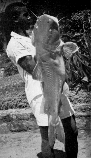
Max length : 150 cm TL mannelijk / geslacht onbekend; (Ref. 3236); max. gepubliceerd gewicht: 135.0 kg (Ref. 3236)
Levenscyclus en paargedrag
Maturiteit | Voortplanting | Paaien | Eieren | Fecunditeit | Larven
Risch, L. and E.J. Vreven, 2007. Claroteinae. p. 607-629. In M.L.J. Stiassny, G.G. Teugels and C.D. Hopkins (eds.) The fresh and brackish water fishes of Lower Guinea, West-Central Africa. Volume I. Collection Faune et Flore tropicales 42. Institut de Recherche pour le Développement, Paris, France, Muséum National d’Histoire Naturelle, Paris, France, and Musée Royal de l’Afrique Centrale, Tervuren, Belgium. 800 pp. (Ref. 74659)
Status op de Rode Lijst van het IUCN (Ref. 130435: Version 2025-1)
Gebruik door de mens
Tools
Speciale rapporten
Download XML
Internetbronnen
Estimates based on models
Fylogenetische diversiteitsindex (Ref.
82804): PD
50 = 0.5000 [Uniqueness, from 0.5 = low to 2.0 = high].
Bayesian length-weight: a=0.01122 (0.00514 - 0.02450), b=3.04 (2.87 - 3.21), in cm total length, based on all LWR estimates for this body shape (Ref.
93245).
Trofisch niveau (Ref.
69278): 3.4 ±0.4 se; based on size and trophs of closest relatives
Weerstandsvermogen (Ref.
120179): laag, minimale populatieverdubbelingstijd 4,5-14 jaar (Preliminary K or Fecundity.).
Fishing Vulnerability (Ref.
59153): Very high vulnerability (90 of 100).
🛈