>
Scombriformes (Mackerels) >
Trichiuridae (Cutlassfishes) > Aphanopodinae
Etymology: Aphanopus: Greek, aphanes = hidden + Greek, pous = foot (Ref. 45335).
Environment: milieu / Zona climática / intervalo de profundidade / distribution range
Ecologia
marinhas bentopelágico; intervalo de profundidade 300 - 1408 m (Ref. 6181). Deep-water; 50°N - 35°S, 105°E - 14°E (Ref. 6181)
Atlantic Ocean: in moderately warm and tropical waters; it has not been found only off the coast of South America. In the eastern Atlantic, it is found off western Sahara, Congo and Angola, from Sierra Leone submarine rise and Pilberry Seamount (Ref. 10818).
Tamanho / Peso / Idade
Maturidade: Lm ? range ? - ? cm
Max length : 148 cm TL macho/indeterminado; (Ref. 108735)
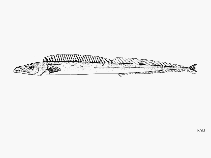
Espinhos dorsais (total) : 39 - 44; Raios dorsais (total) : 54 - 59; Espinhos anais: 2; Raios anais : 46 - 50; Vértebras: 102 - 108. Pelvic fins represented by a single spine in juveniles inserted before the base of the pectoral fins but entirely absent in adults. Body is coppery black with iridescent tint. The inside of the mouth and gill cavities black.
Body shape (shape guide): eel-like; Cross section: compressed.
Adults benthopelagic from 800 to 1,350 m, juveniles mesopelagic from 300 to 500 m (Ref. 6181). Up until recently, fisheries catch landings of A. carbo, a sympatric species in the waters of Canary and Madeira islands, were mixed with A. intemedius.
Ciclo de vida ou comportamento de acasalamento
Maturidade | Reprodução | Desova | Ovos | Fecundidade | Larvas
Displays determinate fecundity (Ref. 108695). Mature individuals undertake horizontal migration to spawning and nursery grounds (Ref. 108708).
Nakamura, I. and N.V. Parin, 1993. FAO Species Catalogue. Vol. 15. Snake mackerels and cutlassfishes of the world (families Gempylidae and Trichiuridae). An annotated and illustrated catalogue of the snake mackerels, snoeks, escolars, gemfishes, sackfishes, domine, oilfish, cutlassfishes,. scabbardfishes, hairtails, and frostfishes known to date. FAO Fish. Synop. 125(15):136 p. (Ref. 6181)
Status na Lista Vermelha da UICN (Ref. 130435: Version 2025-1)
Ameaça para os humanos
Harmless
Uso pelos humanos
Pescarias: espécies comerciais
Ferramentas
Relatórios especiais
Baixar XML
Fontes da internet
Estimates based on models
Preferred temperature (Ref.
123201): 6.2 - 13.7, mean 9.4 °C (based on 190 cells).
Índice de diversidade filogenética (Ref.
82804): PD
50 = 0.5078 [Uniqueness, from 0.5 = low to 2.0 = high].
Bayesian length-weight: a=0.00110 (0.00060 - 0.00201), b=3.09 (2.93 - 3.25), in cm total length, based on LWR estimates for this species & (Sub)family-body (Ref.
93245).
Nível Trófico (Ref.
69278): 4.3 ±0.7 se; based on size and trophs of closest relatives
Resiliência (Ref.
120179): Baixo, tempo mínimo de duplicação da população 4,5 - 14 anos (K=0.121; tmax=15).
Fishing Vulnerability (Ref.
59153): High vulnerability (62 of 100).
🛈
Climate Vulnerability (Ref.
125649): Moderate vulnerability (42 of 100).
🛈
Nutrients (Ref.
124155): Calcium = 7.2 [3.4, 23.3] mg/100g; Iron = 0.204 [0.058, 0.575] mg/100g; Protein = 15.8 [14.1, 17.6] %; Omega3 = 0.277 [0.112, 0.714] g/100g; Selenium = 42.9 [11.2, 142.5] μg/100g; VitaminA = 11.3 [2.0, 59.4] μg/100g; Zinc = 0.373 [0.178, 0.733] mg/100g (wet weight);