Classification / Names
Noms communs | Synonymes | Catalog of Fishes(Genre, Espèce) | ITIS | CoL | WoRMS | Cloffa
>
Siluriformes (Catfishes) >
Loricariidae (Armored catfishes) > Loricariinae
Etymology: Loricaria: Latin, lorica, loricare = cuirass of corslet of leather; 1706 + Greek, ichthys = fish (Ref. 45335); thomasi: Name 'thomasi' in honor of Dr. Matthew R. Thomas, ichthyologist at the Kentucky Department of Fish and Wildlife Resources, for his contributions on the taxonomy and systematics of the genus Loricaria.
Environment: milieu / climate zone / profondeur / distribution range
Écologie
; eau douce démersal. Tropical
South America: Colombia and Venezuela.
Taille / Poids / Âge
Maturité: Lm ? range ? - ? cm
Max length : 18.6 cm SL mâle / non sexé; (Ref. 133466)
Description synthétique
Clés d'identification | Morphologie | Morphométrie
Rayons mous dorsaux (Total) : 7; Rayons mous anaux: 5. This species is distinguished from its congeners by the following set of characters: striking development of its buccal tuft; a medial cluster of 25-29 simple, elongate papillae, supported by a fleshy protuberance from the anterior roof of the buccal cavity, internal to premaxillae (Ref. 133466).
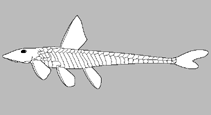
Body shape (shape guide): elongated; Cross section: oval.
Facultative air-breathing in the genus; Gut examination of the species revealed its diet composed of detritus and a variety of nonbiting midge larvae (Chironomidae) in the subfamilies Chironominae (Cryptochironomus, Pelomus) and Tanypodinae (Coelotanypus) (Ref. 133466).
Life cycle and mating behavior
Maturité | Reproduction | Frai | Œufs | Fécondité | Larves
Provenzano, F.R. and M.H. Sabaj, 2024. Description of a new species of Loricaria Linnaeus 1758 (Siluriformes: Loricariidae) from the Orinoco Basin. Proceedings of the Academy of Natural Sciences of Philadelphia 168:211-220. (Ref. 133466)
Statut dans la liste rouge de l'IUCN (Ref. 130435: Version 2025-1)
Menace pour l'homme
Harmless
Utilisations par l'homme
Pêcheries: sans intérêt
Outils
Articles particuliers
Télécharger en XML
Sources Internet
Estimates based on models
Phylogenetic diversity index (Réf.
82804): PD
50 = 0.5000 [Uniqueness, from 0.5 = low to 2.0 = high].
Niveau trophique (Réf.
69278): 2.5 ±0.2 se; based on size and trophs of closest relatives
Résilience (Réf.
120179): Milieu, temps minimum de doublement de population : 1,4 à 4,4 années (Preliminary K or Fecundity.).
Fishing Vulnerability (Ref.
59153): Low vulnerability (13 of 100).
🛈