>
Gymnotiformes (Knifefishes) >
Hypopomidae (Bluntnose knifefishes)
Etymology: Brachyhypopomus: Greek, brachys, eia = short + Greek, hypo = under + Greek, poma, -atos = cover (Ref. 45335); verdii: Named for Lorgio Verdi Olivares, Peruvian conservation biologist, for his support to WGRC and NRL. A noun in the genitive case.
Eponymy: Dr Absalon Lorgio Verdi Olivares is a Peruvian conservation biologist at National University of the Peruvian Amazon, Iquitos, where he was Director of the Graduate School. [...] (Ref. 128868), visit book page.
Environment: milieu / Klimaatzone / Diepte / distribution range
Ecologie
; zoet water benthopelagisch. Tropical
South America: río Marañón and río Ucayali in the upper Amazon basin, Peru.
Grootte / Gewicht / Leeftijd
Maturiteit: Lm ? range ? - ? cm
Max length : 12.0 cm TL mannelijk / geslacht onbekend; (Ref. 116763); 11.2 cm TL (female)
Korte beschrijving
Determinatiesleutels | Morfologie | Morfometrie
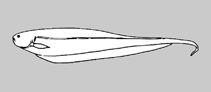
Anale zachte stralen: 194 - 225. Brachyhypopomus verdii is distinguished from other species of the genus Brachyhypopomus by the following combination of characters: 24-26 precaudal vertebrae (vs. 15-23 in all congeners except B. belindae and B. draco); 3 bilateral columns of electrocytes at the anal-fin terminus (vs. 4-5 in B. belindae); presence of continuous or discontinuous dark vertical or diagonally oriented bands or saddles on body surface dorsal to lateral line (vs. absence of oblique bands or saddles on body surface dorsal to lateral line in B. draco (Ref. 116763).
Body shape (shape guide): elongated.
Facultative air-breathing in the genus (Ref. 126274); It inhabits low-conductivity blackwater terra firme rainforest streams and swamps, where it is found in association with submerged roots and leaf litter. In the area of the type locality, it feeds on small aquatic invertebrates and spawns during the rainy season, approximately December to April. In the lower río Ucayali of the type locality region, it occurs sympatrically and syntopically with Brachyhypopomus beebei, B. benjamini, B. brevirostris, B. sullivani, and B. walteri (Ref. 116763).
Levenscyclus en paargedrag
Maturiteit | Voortplanting | Paaien | Eieren | Fecunditeit | Larven
Crampton, W.G.R., C.D. de Santana, J.C. Waddell and N.R. Lovejoy, 2017. A taxonomic revision of the Neotropical electric fish genus Brachyhypopomus (Ostariophysi: Gymnotiformes: Hypopomidae), with descriptions of 15 new species. Neotrop. ichthyol. 14(4):e150146. (Ref. 116763)
Status op de Rode Lijst van het IUCN (Ref. 130435: Version 2025-1)
Gevaar voor de mens
Harmless
Gebruik door de mens
Visserij: van geen belang
Tools
Speciale rapporten
Download XML
Internetbronnen
Estimates based on models
Fylogenetische diversiteitsindex (Ref.
82804): PD
50 = 0.5000 [Uniqueness, from 0.5 = low to 2.0 = high].
Bayesian length-weight: a=0.00372 (0.00139 - 0.00994), b=3.06 (2.83 - 3.29), in cm total length, based on LWR estimates for this (Sub)family-body shape (Ref.
93245).
Trofisch niveau (Ref.
69278): 3.1 ±0.4 se; based on size and trophs of closest relatives
Fishing Vulnerability (Ref.
59153): Low vulnerability (10 of 100).
🛈