>
Gymnotiformes (Knifefishes) >
Hypopomidae (Bluntnose knifefishes)
Etymology: Brachyhypopomus: Greek, brachys, eia = short + Greek, hypo = under + Greek, poma, -atos = cover (Ref. 45335); regani: Named for Charles Tate Regan (1878-1943), British ichthyologist, for his contributions to Neotropical ichthyology. A noun in the genitive case.
Eponymy: Charles Tate Regan (1878–1943) was a British ichthyologist. [...] (Ref. 128868), visit book page.
Environment: milieu / Zona climática / intervalo de profundidade / distribution range
Ecologia
; Água doce bentopelágico. Tropical
South America: Brazil, Ecuador, Guyana, Peru, Suriname, and Venezuela. Known from the Amazon basin, Orinoco drainage, the Essequibo River, and some coastal drainages of Guyana.
Tamanho / Peso / Idade
Maturidade: Lm ? range ? - ? cm
Max length : 15.6 cm TL macho/indeterminado; (Ref. 116763); 14.1 cm TL (female)
Descrição suscinta
Chaves de identificação | Morfologia | Morfometria
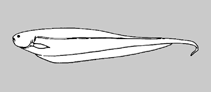
Raios anais : 165 - 205. Brachyhypopomus regani is distinguished from other species of the genus Brachyhypopomus by the following combination of characters: presence of accessory electric organ over opercular region (vs. absence in all congeners except B. bombilla and B. menezesi); dorsal surface with large dark blotches against a lighter background (vs. dorsal surface speckled with small brown chromatophores on a pale background in B. bombilla); and caudal filament length 11.1-17.9% of length to end of anal fin (vs. 24.-33.3% in B. menezesi) (Ref. 116763).
Body shape (shape guide): elongated.
Facultative air-breathing in the genus (Ref. 126274); Occurs only in high-conductivity whitewater floodplains in floating rafts of macrophytes and leaf
litter of newly-inundated forest. Feeds on aquatic insect larvae, microcrustacea, and other small aquatic invertebrates with a predominance of Chironomidae larvae. Spawns in floating macrophytes during the rising and high water period (Ref. 116763).
Ciclo de vida ou comportamento de acasalamento
Maturidade | Reprodução | Desova | Ovos | Fecundidade | Larvas
Crampton, W.G.R., C.D. de Santana, J.C. Waddell and N.R. Lovejoy, 2017. A taxonomic revision of the Neotropical electric fish genus Brachyhypopomus (Ostariophysi: Gymnotiformes: Hypopomidae), with descriptions of 15 new species. Neotrop. ichthyol. 14(4):e150146. (Ref. 116763)
Status na Lista Vermelha da UICN (Ref. 130435: Version 2025-1)
Ameaça para os humanos
Harmless
Uso pelos humanos
Ferramentas
Relatórios especiais
Baixar XML
Fontes da internet
Estimates based on models
Índice de diversidade filogenética (Ref.
82804): PD
50 = 0.5000 [Uniqueness, from 0.5 = low to 2.0 = high].
Bayesian length-weight: a=0.00372 (0.00139 - 0.00994), b=3.06 (2.83 - 3.29), in cm total length, based on LWR estimates for this (Sub)family-body shape (Ref.
93245).
Nível Trófico (Ref.
69278): 3.1 ±0.4 se; based on size and trophs of closest relatives
Fishing Vulnerability (Ref.
59153): Low vulnerability (10 of 100).
🛈