Classification / Names
Noms communs | Synonymes | Catalog of Fishes(Genre, Espèce) | ITIS | CoL | WoRMS | Cloffa
>
Cichliformes (Cichlids, convict blennies) >
Cichlidae (Cichlids) > Cichlasomatinae
Etymology: stalsbergi: Named for Alf Stalsberg (Tjodalyng, Norway), the collector of the holotype, in recognition of his longstanding commitment to increase the knowledge about cichlid fishes.
Eponymy: Alf Stalsberg of Tjodalyng, Norway, is a cichlid aquarist who collected the type. He was honoured for his “…longstanding commitment to increase the knowledge about cichlid fishes.” (Ref. 128868), visit book page.
Environment: milieu / climate zone / profondeur / distribution range
Écologie
; eau douce démersal; pH range: 7.7 - 9.2; dH range: 6.7 - 40. Tropical; 23°C - 28°C (Ref. 82770); 5°S - 14°S, 75°W - 81°W
South America: trans-andean rivers and lakes at the Peruvian Pacific coast.
Taille / Poids / Âge
Maturité: Lm ? range ? - ? cm
Max length : 11.3 cm SL mâle / non sexé; (Ref. 82770); 10.3 cm SL (female)
Description synthétique
Clés d'identification | Morphologie | Morphométrie
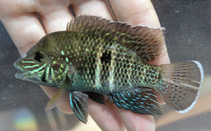
Épines dorsales (Total) : 13 - 14; Rayons mous dorsaux (Total) : 11 - 13; Épines anales: 3; Rayons mous anaux: 8 - 10. Andinoacara stalsbergi is a member of the Andinoacara rivulatus group. It closely resembles A. rivulatus with which it shares the comparatively large size (TL >200 mm in males), the color pattern of the cheeks and a light vertical stripe anterior and posterior to the rectangular midlateral spot. It can be easily diagnosed from this species by specific color characteristics, viz. having a conspicuous white margin in both the dorsal and caudal fin and on the body sides scales with light centers and contrasting dark marginal lines forming a fine reticulate pattern (Ref. 82770).
Andinoacara stalsbergi was caught from various localities. This was collected in brackish lake, Laguna de Vegueta. The banks of this lake were partly covered with aquatic and submerged terrestrial vegetation (Hydrocotyle bonariensis and Bacopa monnieri). This species was found in association with other fish fauna such as Bryconamericus peruvianus, Lebiasina bimaculata (Characidae), Poecilia reticulata (Poeciliidae) and Dorminator latifrons (Eleotridae). Another collection site was Río Pisco near Independencia, a clear river approximately 10 m wide with bottom covered with sand and rocks and without submerged vegetation. This species was also recorded from Laguna Ñapique, characterized by turbid water and sandy bottom. In Laguna San Ramón, the associated fish fauna of this species were Tilapia sp. (Cichlidae) and Bryconamericus peruanus. Ecological data suggests that this species adapts well to very alkaline and hard water rich in dissolved minerals and even tolerates brackish water (Ref. 82770).
Life cycle and mating behavior
Maturité | Reproduction | Frai | Œufs | Fécondité | Larves
Data based on aquarium observations (Ref. 82770).
Musilová, Z., I. Schindler and W. Staeck, 2009. Description of Andinoacara stalsbergi sp. n. (Teleostei: Cichlidae: Cichlasomatini) from Pacific coastal rivers in Peru, and annotations on the phylogeny of the genus. Vertebr. Zool. 59(2):131-141. (Ref. 82770)
Statut dans la liste rouge de l'IUCN (Ref. 130435: Version 2025-1)
Menace pour l'homme
Harmless
Utilisations par l'homme
Outils
Articles particuliers
Télécharger en XML
Sources Internet
Estimates based on models
Phylogenetic diversity index (Réf.
82804): PD
50 = 0.5039 [Uniqueness, from 0.5 = low to 2.0 = high].
Bayesian length-weight: a=0.02754 (0.01560 - 0.04864), b=3.07 (2.92 - 3.22), in cm total length, based on LWR estimates for this species & (Sub)family-body (Ref.
93245).
Niveau trophique (Réf.
69278): 3.2 ±0.4 se; based on size and trophs of closest relatives
Résilience (Réf.
120179): Haut, temps minimum de doublement de population inférieur à 15 mois (Preliminary K or Fecundity.).
Fishing Vulnerability (Ref.
59153): Low vulnerability (10 of 100).
🛈