Classification / Names
Noms communs | Synonymes | Catalog of Fishes(Genre, Espèce) | ITIS | CoL | WoRMS | Cloffa
>
Siluriformes (Catfishes) >
Loricariidae (Armored catfishes) > Hypostominae
Etymology: Hypostomus: Greek, hypo = under + Greek, stoma = mouth (Ref. 45335); pagei: Named for Dr. Lawrence M. Page for his help in collecting the majority of the specimens of this species.
Eponymy: Professor Dr Lawrence ‘Larry’ Merle Page (d: 1944) is an American zoologist who is (2002–present) Curator of Fishes at the Florida Museum of Natural History and Director (2011–present), iDigBio (Coordinating Center for Advancing Digitization of [...] (Ref. 128868), visit book page.
Environment: milieu / climate zone / profondeur / distribution range
Écologie
; eau douce démersal. Tropical
South America: Venezuela in the Rio Aroa, Rio Tocuyo and Rio Yaracuy basins (Ref. 50589). Reported from Suriname (Ref. 97225).
Taille / Poids / Âge
Maturité: Lm ? range ? - ? cm
Max length : 18.9 cm SL mâle / non sexé; (Ref. 97225)
Description synthétique
Clés d'identification | Morphologie | Morphométrie
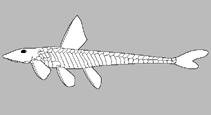
Light, gray brown color with the spots considerably faded or absent. Juveniles have caudal fin darkest along both spines and at the base, clear medially, a color pattern not found in any other members of the Hypostomus cochliodon group. Most similar to H. hondae and H. plecostomoides but differs by the general absence of spots on the caudal fin and/or caudal-fin spines (H. pagei may have very faint spots on the caudal-fin spines; some H. plecostomoides lack spots on the caudal-fin spines, but the spines are almost black instead of light gray-brown) and by having shorter pectoral-fin spine (reaching 0-1 plates beyond pelvic fin when depressed below the pelvic fin vs. 2-3 plates with the exception of one specimen of H. pagei that has pectoral-fin spines reaching two plates beyond the pelvic fin and the one specimen of H. plecostomoides examined from the Lago Valencia drainage that has pectoral-fin spines that do not reach beyond the pelvic fin) (Ref. 50589).
Body shape (shape guide): elongated.
Facultative air-breathing in the genus (Ref. 126274)
Life cycle and mating behavior
Maturité | Reproduction | Frai | Œufs | Fécondité | Larves
Armbruster, J.W., 2003. The species of the Hypostomus cochliodon group (Siluriformes: Loricariidae). Zootaxa 249:1-60. (Ref. 50589)
Statut dans la liste rouge de l'IUCN (Ref. 130435: Version 2025-1)
Menace pour l'homme
Harmless
Utilisations par l'homme
Pêcheries: sans intérêt
Outils
Articles particuliers
Télécharger en XML
Sources Internet
Estimates based on models
Phylogenetic diversity index (Réf.
82804): PD
50 = 0.5000 [Uniqueness, from 0.5 = low to 2.0 = high].
Bayesian length-weight: a=0.01622 (0.00733 - 0.03589), b=2.96 (2.79 - 3.13), in cm total length, based on LWR estimates for this Genus-body shape (Ref.
93245).
Résilience (Réf.
120179): Milieu, temps minimum de doublement de population : 1,4 à 4,4 années (Preliminary K or Fecundity.).
Fishing Vulnerability (Ref.
59153): Low vulnerability (13 of 100).
🛈