>
Gobiiformes (Gobies) >
Gobiidae (Gobies) > Gobiinae
Etymology: Coryphopterus: Greek, koryphe = summit + Greek, pteron = fin, wing (Ref. 45335).
More on author: Gill.
Environment: milieu / climate zone / profondeur / distribution range
Écologie
marin récifal; profondeur 2 - 45 m (Ref. 9710). Tropical; 37°N - 33°S
Western Atlantic: North Carolina, USA and Bermuda to Santa Catarina, Brazil (Ref. 57756); throughout the Caribbean Sea.
Taille / Poids / Âge
Maturité: Lm ? range ? - ? cm
Max length : 8.0 cm TL mâle / non sexé; (Ref. 9710)
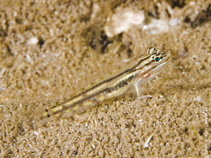
Épines dorsales (Total) : 6; Rayons mous dorsaux (Total) : 10; Épines anales: 1; Rayons mous anaux: 10; Vertèbres: 26. With black spot on side of head above gill cover (Ref. 26938). Individuals from white sand bottom and clear water are pale with two rows of faint yellow spots on side of body; a horizontal orange streak extending posteriorly from middle of eye to above pectoral fin; a row of dusky spots at base of dorsal fins. Individuals from darker bottom and more turbid water are more darkly pigmented; there are 2 rows of dark spots on side of body and one mid-dorsally, fins dusky (Ref. 13442).
Body shape (shape guide): elongated.
Inhabits clear white sandy areas near deep reefs and grassy and rocky areas. Burrows in the sand and the male guards the eggs (Ref. 5521). The Bridled goby, which has X-shaped marks and spots, occurs in both clear and more murky inshore waters, while the paler, very similar Sand goby, Coryphopterus tortugae [= Coryphopterus glaucofraenum], occurs over white sand (Ref. 26938).
Life cycle and mating behavior
Maturité | Reproduction | Frai | Œufs | Fécondité | Larves
Oviparous, demersal spawner (Ref. 101194). Both male and female spawn with many individuals in small contiguous territories (Ref. 240).
Robins, C.R. and G.C. Ray, 1986. A field guide to Atlantic coast fishes of North America. Houghton Mifflin Company, Boston, U.S.A. 354 p. (Ref. 7251)
Statut dans la liste rouge de l'IUCN (Ref. 130435: Version 2025-1)
Menace pour l'homme
Harmless
Utilisations par l'homme
Pêcheries: commercial; Aquarium: Commercial
Outils
Articles particuliers
Télécharger en XML
Sources Internet
Estimates based on models
Preferred temperature (Réf.
123201): 24.4 - 28, mean 27 °C (based on 254 cells).
Phylogenetic diversity index (Réf.
82804): PD
50 = 0.5001 [Uniqueness, from 0.5 = low to 2.0 = high].
Bayesian length-weight: a=0.00759 (0.00466 - 0.01235), b=3.04 (2.91 - 3.17), in cm total length, based on LWR estimates for this species & (Sub)family-body (Ref.
93245).
Niveau trophique (Réf.
69278): 2.7 ±0.4 se; based on diet studies.
Résilience (Réf.
120179): Haut, temps minimum de doublement de population inférieur à 15 mois (Preliminary K or Fecundity.).
Fishing Vulnerability (Ref.
59153): Low vulnerability (10 of 100).
🛈
Nutrients (Ref.
124155): Calcium = 166 [74, 326] mg/100g; Iron = 0.879 [0.427, 1.743] mg/100g; Protein = 17.7 [15.7, 19.4] %; Omega3 = 0.0941 [, ] g/100g; Selenium = 28.8 [13.0, 66.9] μg/100g; VitaminA = 115 [28, 450] μg/100g; Zinc = 2.44 [1.56, 3.66] mg/100g (wet weight);