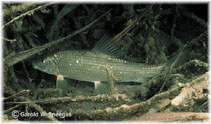
Environment: milieu / climate zone / rango de profundidad / distribution range
Ecología
; agua dulce demersal. Subtropical; 32°N - 23°N
North America: USA; occurrence in Mexico is uncertain.
Tamaño / Peso / Age
Madurez: Lm ? range ? - ? cm
Max length : 65.0 cm TL macho / no sexado; (Ref. 5723)
Inhabits lakes and deep runs and pools of small to medium rivers (Ref. 52299). Feeds on aquatic insects, mollusks, amphipods, ostracods, algae, plant seeds and fish (Ref. 79012).
Life cycle and mating behavior
Madurez | Reproducción | Puesta | Huevos | Fecundidad | Larva
Nelson, J.S., E.J. Crossman, H. Espinosa-Pérez, L.T. Findley, C.R. Gilbert, R.N. Lea and J.D. Williams, 2004. Common and scientific names of fishes from the United States, Canada, and Mexico. American Fisheries Society, Special Publication 29, Bethesda, Maryland. ix, 386 p. + 1 CD. (Ref. 52299)
IUCN Red List Status (Ref. 130435: Version 2025-1)
Threat to humans
Harmless
Human uses
Herramientas
Special reports
Download XML
Fuentes de Internet
Estimates based on models
Phylogenetic diversity index (Referencia
82804): PD
50 = 0.5000 [Uniqueness, from 0.5 = low to 2.0 = high].
Bayesian length-weight: a=0.00525 (0.00220 - 0.01254), b=3.09 (2.88 - 3.30), in cm total length, based on LWR estimates for this (Sub)family-body shape (Ref.
93245).
Nivel trófico (Referencia
69278): 3.1 ±0.4 se; based on size and trophs of closest relatives
Resiliencia (Referencia
120179): Bajo, población duplicada en un tiempo mínimo de 4.5-14 años (Preliminary K or Fecundity.).
Fishing Vulnerability (Ref.
59153): Moderate to high vulnerability (46 of 100).
🛈