>
Salmoniformes (Salmons) >
Salmonidae (Salmonids) > Coregoninae
Etymology: Prosopium: Greek, prosopon = face (Ref. 45335); coulterii: Named after Dr. J.M. Coulter, a distinguished botanist.
Eponymy: Dr John Merle Coulter (1851–1928) was an American botanist. [...] (Ref. 128868), visit book page.
More on authors: Eigenmann & Eigenmann.
Environment: milieu / climate zone / نطاق العمق / distribution range
البيئة
; المياه العذبة قاعية التغذية و المعيشة; نطاق العمق 18 - 168 m (Ref. 27547), usually 55 - 70 m (Ref. 1998). Temperate; 59°N - 47°N
North America: three disjunct areas: Lake Superior in Ontario, Canada and Michigan, USA; Yukon River drainage in Yukon, Canada to Columbia River drainage in western Montana and Washington, USA; and Chignik, Naknek and Wood River drainages in southwest Alaska. Europe: Russia (Ref. 26334).
الحجم / وزن / العمر
النضج: Lm ? range ? - ? cm
Max length : 28.0 cm TL ذكر/ مختلط الجنس; (Ref. 5723); common length : 11.5 cm TL ذكر/ مختلط الجنس; (Ref. 12193); العمر: 9 سنين (Ref. 10320)
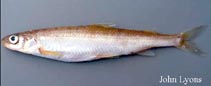
الأشواك الظهرية (المجموع) : 0; الأشعة الظهرية الناعمة (المجموع) : 10 - 13; شوكة شرجية: 0; أشعه شرجية لينه: 10 - 14; فقرات: 49 - 55. Body elongate, almost cylindrical. Head elongate, its length slightly greater than body depth; eye relatively large, its diameter greater than snout length; snout bluntly rounded, overhanging mouth, not obviously pointed, a single flap of skin present between nostrils. Nuptial tubercles developed in both males and females, but more conspicuous in males, and occur on top of head, on scales on back and sides, and on paired fins. Body is brownish above, silvery on sides and white below. Dorsal, caudal, and pectoral fins usually clear, anal and pelvic whitish and immaculate, a faint dark spot sometimes present on base of caudal fin. A series of 12 - 14 similar spots present along the midline of the back, and 7 - 14 dark, round or oval parr marks with diffuse borders present along the lateral line of young and sub adults, although some Alaskan forms retain parr marks even on largest fish.
Body shape (shape guide): elongated; Cross section: oval.
Inhabits lakes and rivers of mountainous areas (Ref. 1998). Feeds mainly on crustaceans and aquatic insect larvae (Ref. 1998). Minimum depth reported from Ref. 1998.
Moves to spawning grounds in the early winter and presumably back into deeper water after spawning. Spawns at night, presumably the eggs are broadcast, settling into interstices in the gravel. Hatching occurs the following spring (Ref. 27547).
Page, L.M. and B.M. Burr, 1991. A field guide to freshwater fishes of North America north of Mexico. Houghton Mifflin Company, Boston. 432 p. (Ref. 5723)
IUCN Red List Status (Ref. 130435: Version 2025-1)
استخدامات بشرية
مصائد: غير ذات اهمية; لعبة سمكه: نعم
أدوات
تقارير خاصة
Download XML
مصادر علي الأنترنت
Estimates based on models
Phylogenetic diversity index (مرجع
82804): PD
50 = 0.5156 [Uniqueness, from 0.5 = low to 2.0 = high].
Bayesian length-weight: a=0.00457 (0.00240 - 0.00872), b=3.14 (2.96 - 3.32), in cm total length, based on LWR estimates for this species & (Sub)family-body (Ref.
93245).
مستوى غذائي (مرجع
69278): 3.1 ±0.35 se; based on food items.
Generation time: 2.0 ( na - na) years. Estimated as median ln(3)/K based on 1
growth studies.
المرونه (مرجع
120179): وسيط, الحد الزمني الأدني لتضاعف عدد أفراد المجتمع 1.4-4.4 سنة (tm=1-2; tmax=9; Fec=103).
Fishing Vulnerability (Ref.
59153): Low vulnerability (25 of 100).
🛈