>
Cichliformes (Cichlids, convict blennies) >
Cichlidae (Cichlids) > Pseudocrenilabrinae
Etymology: Oreochromis: Latin, aurum = gold + Greek, chromis = a fish, perhaps a perch (Ref. 45335).
More on author: Günther.
Environment: milieu / climate zone / Mức độ sâu / distribution range
Sinh thái học
; Nước ngọt Sống nổi và đáy. Tropical; 24°C - 26°C (Ref. 2059); 3°S - 9°S
Africa: endemic to Lake Tanganyika, in the coastal area and river mouths (Ref. 5166, 118630).
Bộ gần gũi / Khối lượng (Trọng lượng) / Age
Chín muồi sinh dục: Lm ? range ? - ? cm
Max length : 42.0 cm TL con đực/không giới tính; (Ref. 118638)
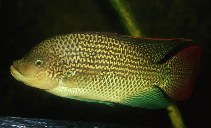
Các tia vây lưng cứng (tổng cộng) : 15 - 17; Các vây lưng mềm (tổng cộng) : 11 - 15; Tia cứng vây hậu môn: 3; Động vật có xương sống: 30 - 31. Diagnosis: A large, deep-bodied species, with wide bands of teeth in the jaws (Ref. 118638). Adult males are covered with complex bright pale blue markings, over the head, flanks and unpaired fins; the background colour can vary from greyish, through yellow to bright red; the lower part of the head is grey-white; the tailfin often head a red background and the dorsal fin has a broad red margin (Ref. 118638). Females and non-territorial males are generally a plain silvery colour, with pearly spots on the flanks; they occasionally exhibit vertical bars and/or horizontal dark bars (Ref. 118638).
Body shape (shape guide): short and / or deep; Cross section: compressed.
It is the dominant tilapiine species in Lake Tanganyika, despite the presence of the normally invasive Nile tilapia (Ref. 118638). It is not normally found far up into inflowing rivers (Ref. 118638). It has been reported to browse the surface film of sheltered waters; stomachs contained large quantities of the diatoms Pinnularia and Navicula with some sand-grains (Ref. 2). A maternal mouthbrooder; males defend territories in shallow water in sheltered sandy or muddy areas, and dig simple pits in the substrate (Ref. 118638). A large fast-growing species well represented in fishery catches in and around Lake Tanganyika; currently being promoted as an aquaculture species and occasionally exported for the aquarium trade (Ref. 118638).
Life cycle and mating behavior
Chín muồi sinh dục | Sự tái sinh sản | Đẻ trứng | Các trứng | Sự sinh sản | Ấu trùng
A maternal mouthbrooder; males defend territories in shallow water in sheltered sandy or muddy areas, and dig simple pits in the substrate (Ref. 118638).
Trewavas, E., 1983. Tilapiine fishes of the genera Sarotherodon, Oreochromis and Danakilia. British Mus. Nat. Hist., London, UK. 583 p. (Ref. 2)
IUCN Red List Status (Ref. 130435: Version 2025-1)
Threat to humans
Harmless
Human uses
Các công cụ
Special reports
Download XML
Các nguồn internet
Estimates based on models
Phylogenetic diversity index (Tài liệu tham khảo
82804): PD
50 = 0.5000 [Uniqueness, from 0.5 = low to 2.0 = high].
Bayesian length-weight: a=0.01862 (0.00830 - 0.04177), b=3.01 (2.82 - 3.20), in cm total length, based on LWR estimates for this (Sub)family-body shape (Ref.
93245).
Mức dinh dưỡng (Tài liệu tham khảo
69278): 2.0 ±0.00 se; based on food items.
Thích nghi nhanh (Tài liệu tham khảo
120179): Trung bình, thời gian nhân đôi của chủng quần tối thiểu là 1.4 - 4.4 năm (Preliminary K or Fecundity.).
Fishing Vulnerability (Ref.
59153): Low to moderate vulnerability (32 of 100).
🛈
Nutrients (Ref.
124155): Calcium = 14.9 [6.0, 78.9] mg/100g; Iron = 1.23 [0.51, 2.99] mg/100g; Protein = 17.6 [15.7, 19.5] %; Omega3 = 0.292 [0.104, 0.856] g/100g; Selenium = 88.7 [30.1, 203.7] μg/100g; VitaminA = 12 [2, 57] μg/100g; Zinc = 1.73 [0.92, 4.17] mg/100g (wet weight);