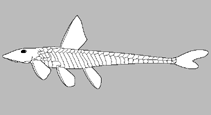
Classification / Names
Common names | Synonyms | Catalog of Fishes(genus, species) | ITIS | CoL | WoRMS | Cloffa
Teleostei (teleosts) >
Siluriformes (Catfishes) >
Loricariidae (Armored catfishes) > Hypostominae
Etymology: Hypancistrus: Greek, hypo = under + Greek, agkistron = hook (Ref. 45335); yudja: Named after the Yudjá (also known as Juruna), a group of indigenous people from the Volta Grande do Xingu; in Tupi language, Yudjá means 'the river owners'.
Environment: milieu / climate zone / depth range / distribution range
Ecology
Freshwater; demersal; depth range 15 - ? m (Ref. 133100). Tropical
Distribution
Countries | FAO areas | Ecosystems | Occurrences | Point map | Introductions | Faunafri
South America: Brazil.
Size / Weight / Age
Maturity: Lm ? range ? - ? cm
Max length : 4.2 cm SL male/unsexed; (Ref. 133100)
Short description
Identification keys | Morphology | Morphometrics
Dorsal spines (total): 2; Dorsal soft rays (total): 7; Anal spines: 1; Anal soft rays: 3 - 4. This species is distinguished from its congeners by its unique color pattern consisting of body with a light tan background and relatively large brown blotches and saddles (Ref. 133100).
Cross section: angular.
This species inhabits the deep portions of the rio Xingu channel and was only found hidden in lateritic conglomerates below 15 m of depth; specimens were collected individually by hand during diving sessions. Specimens kept in captivity were observed to be fairly shy, remains secluded in caves for most of the day. Expert aquarium hobbyists have successfully bred this species with the female laying around 15-20 eggs in a cave that is protected by the male. The fry grows slowly in captivity, usually taking two years or more to reach maturity. Under prime conditions they will reach 4-5 cm TL in about a year.
Life cycle and mating behavior
Maturity | Reproduction | Spawning | Eggs | Fecundity | Larvae
Sousa, L. M. de, E.B. de Sousa, R.R. de Oliveira, M.H. Sabaj Pérez, Zuanon. J. and Rapp Py-Daniel. L., 2025. Two new species of Hypancistrus (Siluriformes: Loricariidae) from the rio Xingu, Amazon, Brazil. Neotropical Ichthyol. 23(1):e240080:1-25. (Ref. 133100)
IUCN Red List Status (Ref. 130435: Version 2025-1)
Threat to humans
Harmless
Human uses
Fisheries: commercial; aquarium: commercial
Tools
Special reports
Download XML
Internet sources
Estimates based on models
Phylogenetic diversity index (Ref.
82804): PD
50 = 0.5005 [Uniqueness, from 0.5 = low to 2.0 = high].
Resilience (Ref.
120179): High, minimum population doubling time less than 15 months (Preliminary K or Fecundity.).
Fishing Vulnerability (Ref.
59153): Low vulnerability (10 of 100).
🛈